


The Complete Guide to Building a Strong Community
A group of people who happen to share a space feels nothing like a community that knows and looks out for each other. What makes the difference, and how do you create it on purpose?
For a church, community isn’t an afterthought. It’s the point. Here’s what a strong community is made of, and how to build one that lasts.
What Is a Community?
A community is a group of people connected by something they share. A purpose, a set of values, a place, a faith. But being together isn't the same as belonging. People can sit in the same building, or the same group chat, week after week and stay strangers.
Three things turn a group into a community.
A sense of belonging. People need to feel they have a valued place, not just a seat: accepted, understood and trusted by the people around them. Without it, members stay acquaintances.
A shared purpose. A community forms around a reason to be together. In a church that might be worship, service or caring for one another. The clearer the purpose, the stronger the pull to join in.
Layers of connection. Most communities have a core, often a team or a group of leaders, and around it outer circles: members, families, volunteers and newer faces still finding their feet. Smaller community groups form within the wider church. The more of those layers a person belongs to, the more people they can turn to.
A community is more than a gathering of people. It’s a place to belong, to contribute and to grow alongside others.
Characteristics of a Strong Community
Belonging, purpose and connection are what a community is made of. These are the qualities that make one strong.
Shared responsibility. In a strong community, people look out for one another rather than keeping to their own corner. When one person is struggling, others step in and carry the load. That mutual reliance is where trust begins.
Empathy and care. Trust takes time, and it grows when people feel that others genuinely care. Empathy means understanding and valuing what someone else is carrying, and acting on it. That is what deepens teamwork into friendship.
Open communication. People need to know what is going on, feel able to ask questions and trust they will be heard. Without it, people are left to guess, and things get misunderstood.
Shared values. People join and stay because they feel connected to what the group stands for. When personal values line up with the community's, people commit. When that alignment fades, they drift. A strong community says what it values, clearly and often, so everyone knows what they’re part of.
Community vs Culture: What’s the Difference?
Culture and community mean different things. One is how a group behaves, the other is the people themselves.
Culture is the how. It’s the unwritten set of values and behaviours that become second nature in a group: how people speak to each other, what gets celebrated, what’s not tolerated. Culture is shaped over time by how a community communicates, and it guides everything that happens inside it.
Community is the who. It’s the people themselves, connected by purpose and real relationships. Community reaches beyond a core team to everyone who belongs, from long-standing members to the newest family through the door.
The two work together. When the culture is healthy, the community thrives, because people feel safe, respected and welcome.
A community is also more than turning up. In a church, that's the difference between being in the room and being part of it.
Why Communication Matters
Communication is how belonging is felt, how purpose spreads and how trust is earned or lost. With it, a community doesn’t just function, it flourishes.
Good communication tends to share four habits.
It’s deliberate. It sets clear expectations rather than leaving people to guess, because assumptions are where most things go wrong. Regular updates, clear instructions and space for questions keep everyone moving in the same direction.
It’s open and honest. Trust grows when people are straight about what they mean, and just as straight when plans change. Feedback is welcomed, and acted on. When people feel that, they engage more fully and are more willing to say what they think.
It puts its own people first. It’s easy to pour energy into how a group looks from the outside and neglect what keeps it running on the inside: the weekly update, the quick check-in, the conversation that clears the air. That everyday communication is what earns trust and keeps a community aligned.
It stays true to the purpose. The best communication reflects what the community is about. Nobody needs the values repeated in every message, but how you communicate should keep pointing back to why the community exists.
From Communication to Culture to Community
Communication, culture and community build on each other, in that order.
It starts with communication. When it’s two-way, inclusive and consistent, every small interaction sets the tone for how the group behaves. Do that often enough and it becomes your culture. Culture is really just how a group communicates, repeated until it becomes normal.
Culture is what makes community possible. When people trust the culture around them, they feel safe enough to connect beyond their own role. A team works together, but a community grows together, and that shift only happens where the culture is healthy.
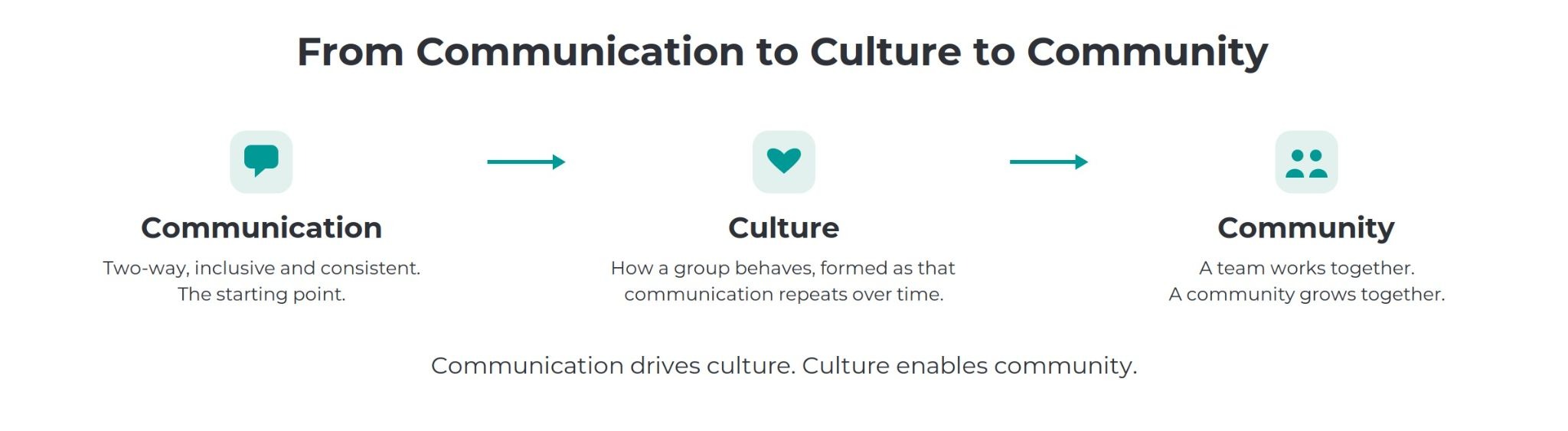
Get the communication right and the rest follows naturally.
How Technology Can Strengthen Community
Community comes from people, not technology. But the tools a community uses shape how well it can communicate, and the wrong tool works against everything you’ve built.
Many churches run on a mix of personal group chats and messaging apps made for something else. They’re familiar, which is why we reach for them. But they were never meant for a church. Personal numbers get passed around and private conversations happen where leaders can’t see them, while groups multiply until nobody is quite sure who is in which. Before long the tool is shaping how your church behaves, not the other way round.
This is where a purpose-built platform helps. Jovo gives your church one place for its whole community to talk, designed around the way churches actually work.
- Everyone joins with just a name and email. No personal phone numbers are shared between members.
- There are no private one-to-one messages, so conversations stay open and accountable. That matters most in youth work and pastoral care.
- Safeguarding leads keep the oversight they need, with key activity logged rather than lost.
- Groups can be set to become inactive when a season, event or project ends.
- It works with the tools churches already use, including ChurchSuite and Planning Center.
- It is GDPR-compliant, and there are no adverts. Members' data is never sold or used to target them.
Every feature on that list protects the same thing. It keeps your church a place where people feel safe, nothing important gets missed and everyone belongs. The right tool gets out of the way and lets a church be a church.
One Place for Your Whole Church
Every person in your church matters. Jovo gives yours one safe place to talk, so the community you’re building has room to grow.

Sign Me Up
Start your 30-day FREE trial and explore Jovo’s features for yourself.


